

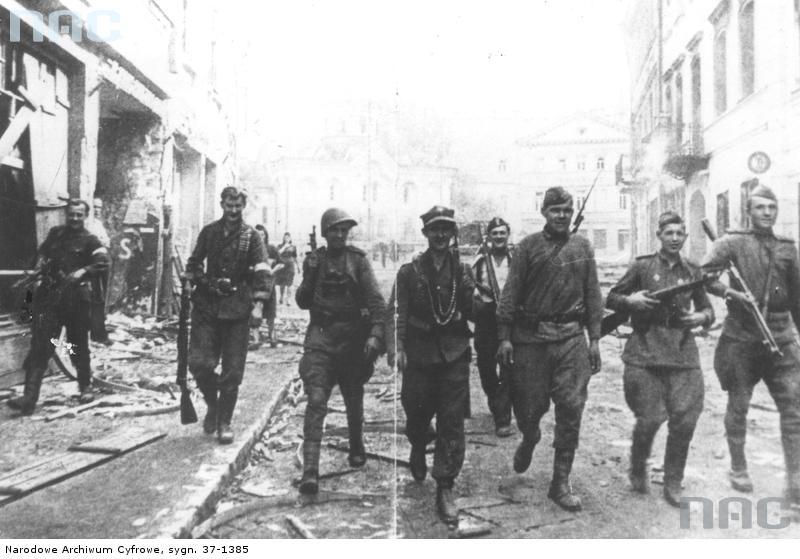
Battle of Vilnius. Soviet Red Army and Polish Armia Krajowa Soldiers patrolling in Vilnius, July 1944. The orthodox church of Vilnius is visible in background. The soldiers of the Second Infantry Fusiliers Division considered the liberation of Wilno and the freeing of their Home Army comrades from the NKVD as the highlight of their war. By this time the Polish and Maavoimat fighting troops were well aware of what had happened in the Soviet-occupied Baltic States during the Soviet occupation and to the Polish Officers in Katyn Forest in April and May 1940. “Allies” or not, no NKVD member could expect to survive a meeting with Maavoimat or Polish units – and as units of the Polish Army moved southwards into the rear of the 3rd Belorussian Front, many did not. And with the constant air cover and close air support provided by the Typhoons and Spitfires of the Polish Air Force and the xxx of the Ilmavoimat, the general attitude towards any Red Army unit that looled askance was “try it”. When accompanied by a flight of Polish Air Force Typhoons or the even more fearsome Ilmavoimat G1’s with their loads of bombs, rockets, napalm and cannon, there were generally no takers.
Battle of Vilnius. Soviet Red Army and Polish Armia Krajowa Soldiers patrolling in Vilnius, July 1944. The orthodox church of Vilnius is visible in background. The soldiers of the Second Infantry Fusiliers Division considered the liberation of Wilno and the freeing of their Home Army comrades from the NKVD as the highlight of their war. By this time the Polish and Maavoimat fighting troops were well aware of what had happened in the Soviet-occupied Baltic States during the Soviet occupation and to the Polish Officers in Katyn Forest in April and May 1940. “Allies” or not, no NKVD member could expect to survive a meeting with Maavoimat or Polish units – and as units of the Polish Army moved southwards into the rear of the 3rd Belorussian Front, many did not. And with the constant air cover and close air support provided by the Typhoons and Spitfires of the Polish Air Force and the xxx of the Ilmavoimat, the general attitude towards any Red Army unit that looled askance was “try it”. When accompanied by a flight of Polish Air Force Typhoons or the even more fearsome Ilmavoimat G1’s with their loads of bombs, rockets, napalm and cannon, there were generally no takers.